The Small Business Innovation Research (SBIR) and the Small Business Technology Transfer (STTR) programs provide non-dilutive funding to develop technology and chart its path towards commercialization. Known as “America’s Seed Fund,” these programs are coordinated by the US Small Business Administration (SBA) and are funded by the 11 agencies, either as contract awards or grants.
The origins of the SBIR program trace back to the 1970s, when concerns grew that the United States was losing its technological competitiveness amid increasing globalization. While there was recognition that the small advanced technology firms were important, they faced barriers in accessing federal R&D funding. This led to the first SBIR program, which began at the National Science Foundation in 1977 as NSF SBIR.
The SBIR program was formally established in 1982 through the Small Business Innovation Development Act and implemented across multiple agencies. The program was reauthorized in 1992 under the Small Business Research and Development Enhancement Act of 1992, which emphasized commercial potential as a criterion for awarding SBIR grants. The Small Business Innovation Research Program Reauthorization Act of 2000 reauthorized the program until 2009.
The STTR program was established in 1992 through the Small Business Technology Transfer Act of 1992. While both the SBIR & STTR programs focus on innovative technologies with the ultimate aim of commercialization, the STTR program requires a cooperative agreement between the small business concern and a non-profit U.S. research institution.
Both SBIR and STTR are typically extended through periodic five-year reauthorizations. With the statutory authority expiring on October 1, 2025, both programs lapsed for more than 6 months until reauthorized on April 13, 2026, by the signing of the Small Business Innovation and Economic Security Act of 2026. Key changes include:
- Increased due diligence of foreign ownership and national security risks
- Strategic Breakthrough Allocation, which is a new option to award SBIR Phase II awards for up to $30 million
- Agencies will set their own cap on proposals an individual company may submit each year (or topic or solicitation)
- Phase I and Phase II awardees may apply for technical and business assistance (TABA) funding. The awardees can choose their own advisors or use the funds for new purposes
- Training for contracting affairs
- Transparency in the data made available
FY25 Analysis of SBIR & STTR Contract Awards
In FY25, $8.07B was awarded to 3,363 companies as SBIR/STTR contracts, an increase of $614M or 8.2% over FY24 awards. In terms of sectors, it is no surprise that the defense agencies accounted for 89% of the total SBIR/STTR awards in FY25, based on funding agencies.
| FY 2023 | FY 2024 | FY 2025 | |
| Defense Agencies | $5,768,045,856 | $6,857,898,863 | $7,193,998,135 |
| Independent Agencies | $297,040,305 | $292,387,339 | $463,869,627 |
| Civil Agencies | $286,318,547 | $297,953,168 | $404,663,723 |
| GRAND TOTAL | $6,351,404,708 | $7,448,239,370 | $8,062,531,484 |
| % increase over the previous year | 17.27% | 8.2% |
In FY25, defense agencies saw a 5% increase, while independent agencies, specifically NASA, saw an increase of 59% over FY24. An analysis of the top 10 agencies funding SBIR and STTR awards in FY25 shows the United States Air Force leading with 41% of total awards, followed by the Department of the Navy at 28%.
| FY 2023 | FY 2024 | FY 2025 | |
| 5700 – AIR FORCE | $2,699,801,538 | $3,103,567,981 | $3,302,853,713 |
| 1700 – NAVY, DEPARTMENT OF | $1,642,960,821 | $2,183,177,686 | $2,255,269,173 |
| 9700 – DEFENSE, DEPARTMENT OF | $640,177,976 | $762,864,786 | $790,381,291 |
| 2100 – ARMY | $708,431,546 | $724,268,120 | $775,963,701 |
| 8000 – NATIONAL AERONAUTICS AND SPACE ADMINISTRATION | $284,792,686 | $276,555,533 | $441,198,827 |
| 7000 – HOMELAND SECURITY | $137,902,451 | $160,900,189 | $213,163,888 |
| 97AS – DEFENSE LOGISTICS AGENCY (DLA) | $76,673,976 | $83,895,721 | $69,372,456 |
| 3600 – DEPARTMENT OF VETERANS AFFAIRS | $12,388,405 | $44,139,028 | $59,761,133 |
| 2000 – TREASURY, DEPARTMENT OF | $0 | $2,295,060 | $36,150,431 |
| 7500 – HEALTH AND HUMAN SERVICES | $103,644,440 | $53,002,094 | $35,482,860 |
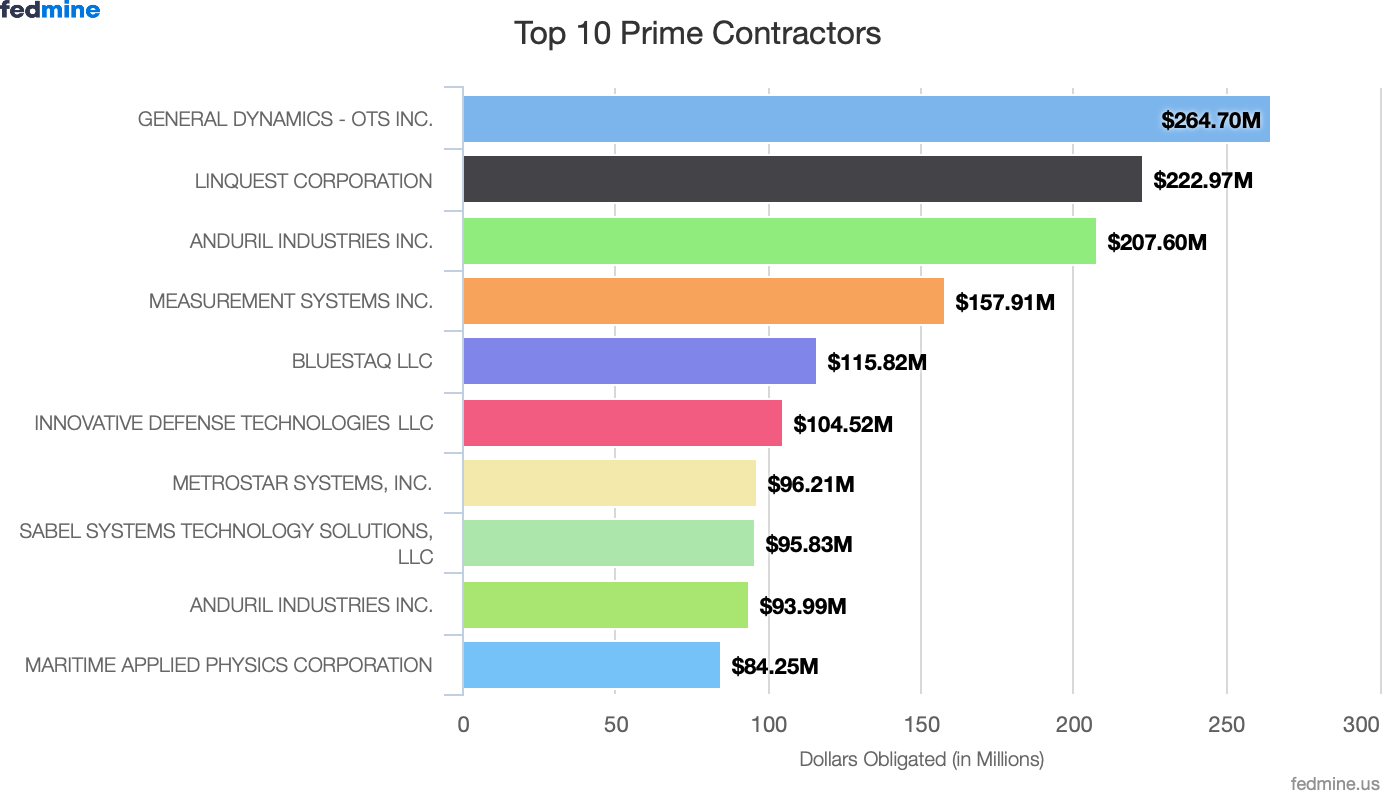
Non-defense agencies, including NASA, the Department of Homeland Security, and the Department of the Treasury, saw significant growth in FY25 compared to FY24. The top companies winning SBIR/STTR awards in FY25 include General Dynamics-OTS Inc, Linquest, and Anduril Industries.
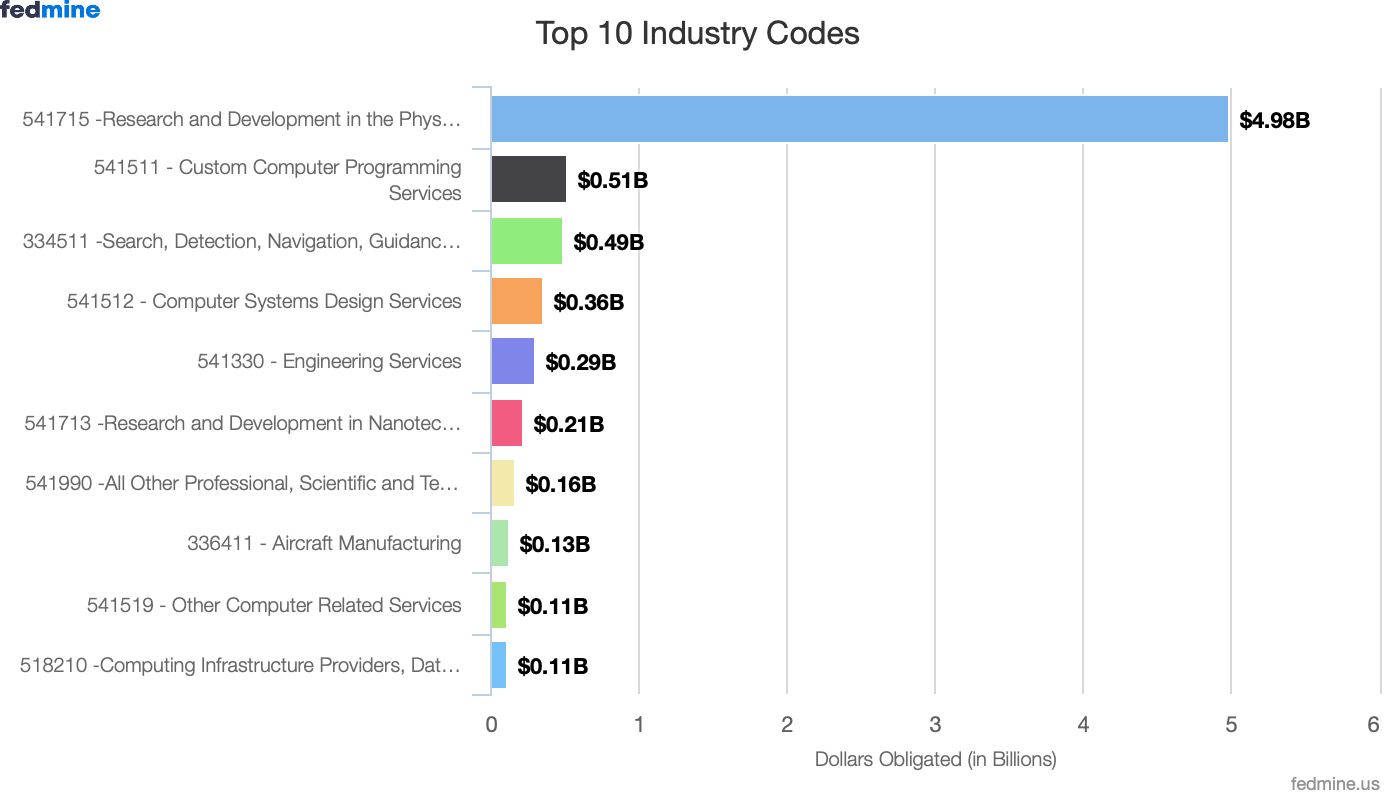
In terms of the top NAICS codes, it is no surprise that R&D NAICS codes account for more than 60% of the awards, followed by computer-related NAICS codes.
It is important to understand the solicitation procedure that was used at the time of awarding these SBIRs &STTRs awards, as it provides an understanding of how an agency is acquiring the solutions, whether it was negotiated or against a research document, or if no solicitation procedure was used. In FY25, more than $3.2B was awarded as “Only One Source”.
| Solicitation Procedure | Sum of Obligated Amount |
| NP – Negotiated Proposal | $ 4,572,094,180 |
| SSS – Only One Source | $ 3,225,644,014 |
| SP1 – Simplified Acquisition | $ 157,945,964 |
| BR – Basic Research | $ 76,251,793 |
| MAFO – Multiple Award Fair opportunity | $ 16,497,966 |
| AS – Alternative Sources | $ 13,683,766 |
| TS – Two Step | $ 467,953 |
| AE – Architect – Engineer | $ (54,152) |
| Grand Total | $ 8,062,531,484 |
Type of Contract Pricing
Fixed Price contracts require a company to be comfortable with its pricing structure and bear more of the risk. More than 61% of the awards were Fixed Price, and 27% were Cost Plus Fixed Fee.
| Type of Contract Pricing | $ Obligated |
| J – Fixed Price | $ 4,947,175,981 |
| U – Cost Plus Fixed Fee | $ 2,201,972,728 |
| Y – Time and Materials | $ 273,589,932 |
| Z – Labor Hours | $ 237,375,410 |
| B – Fixed Price Level of Effort | $ 120,952,873 |
| L – Fixed Price Incentive | $ 114,848,674 |
| V – Cost Plus Incentive | $ 104,311,871 |
| S – Cost No Fee | $ 43,367,987 |
| T – Cost Sharing | $ 14,982,189 |
| M – Fixed Price Award Fee | $ 2,767,252 |
| R – Cost Plus Award Fee | $ 1,186,589 |
| Total | $ 8,062,531,484 |
Use of Set-Asides
$3.78B, or 46% of the awards, used a set-aside procedure. Small business set-asides were the preferred method and accounted for almost all of the set-asides. SDVOSB sole source awards accounted for less than 0.3% of total awards. Regarding subcontracting, approximately 13%, or $1.05B, of the awards had a subcontracting plan requirement.
| Type of Set-Aside | $ Obligated |
| SBA – Small Business Set-Aside — Total | $ 3,699,054,314 |
| SBP – Small Business Set-Aside — Partial | $ 26,265,967 |
| SDVOSBS – SDVOSB Sole Source | $ 21,045,443 |
| 8AN – 8(a) Sole Source | $ 2,301,683 |
| EDWOSBSS – Economically Disadvantaged Women Owned Small Business Sole Source | $ 194,500 |
| WOSBSS – Women Owned Small Business Sole Source | $ 53,808 |
| Total | $ 8,062,531,484 |
The FY25 SBIR/STTR data reinforce a market that is expanding but increasingly concentrated, within the defense sector, particularly the United States Air Force and the Department of the Navy. The use of negotiated and single-source awards, along with fixed-price contracting, underscores a procurement environment that favors speed and mission alignment.
The various phases of SBIR & STTR Programs
The SBIR/STTR programs employ a phased process of soliciting and awarding contracts/awards to fulfill the agency’s mission.
- Phase I – determines the feasibility of the proposed effort or validates the scientific or technical merit of the idea
- Phase II – continues the efforts from the completed Phase I. With a Phase II award, consideration has to be given to the commercialization of the product or solution.
- Phase III – commercialization of the research or technology, typically funded by sources other than the SBIR/STTR program.
Over the years, STTRs have accounted for approximately 10% of the total awards made as SBIRs & STTRs, as shown below.
| FY 2023 | FY 2024 | FY 2025 | |
| SBIR Phase I Awards | $247,395,653 | $283,573,001 | $279,210,599 |
| SBIR Phase II Awards | $2,066,096,098 | $2,346,854,582 | $2,466,881,729 |
| SBIR Phase III Awards | $3,350,327,522 | $3,981,421,175 | $4,613,779,229 |
| Total SBIR Awards | $5,663,819,273 | $6,611,848,759 | $7,359,871,557 |
| STTR Phase I | $58,499,513 | $78,104,594 | $57,592,985 |
| STTR Phase II | $293,027,802 | $400,731,143 | $277,824,242 |
| STTR Phase III | $336,058,121 | $357,554,874 | $367,242,701 |
| Total STTR Awards | $687,585,435 | $836,390,611 | $702,659,927 |
| Total SBIR & STTR Awards | $6,351,404,708 | $7,448,239,370 | $8,062,531,484 |
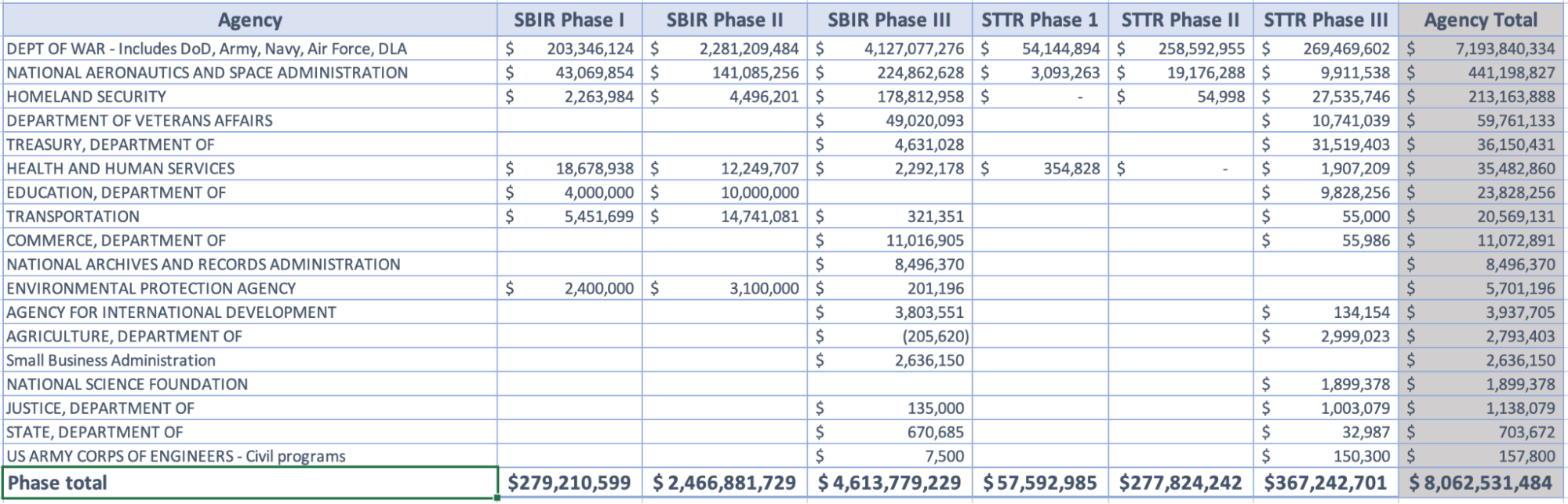
SBIR Phase III awards account for approximately 54% of the awards, followed by SBIR Phase II awards, which account for 31% of the total SBIR & STTR awards. In FY 25, an analysis of the various agencies by the different phases provides a much clearer overview of the award
- Department of War (includes Defense, Navy, Air Force, Army), National Aeronautics and Space Administration (NASA), Department of Health & Human Services (HHS), Department of Transportation, and the Department of Education are funding Phase 1 programs, which could lead to an increase in Phase II funding in the coming years. Phase I funding accounts for 4% of the total awards, with DoD accounting for more than 75% of the Phase I funding, followed by NASA with 14% of the funding.
- Phase III funding for both SBIR & STTR accounts for more than 60% of the contract awards, with the Department of War accounting for more than $4.4B in Phase III funding
In terms of set-asides used across the various phases, the small business set-aside is used for almost all the set-asides.

Of the $3.7B that was awarded using the various set-asides:
- $334M or 9% of the set-asides were for Phase I awards
- Phase II awards accounted for $2.7B or 72% of the set-asides
- Phase III accounted for the balance of $635M
- In addition to the small business set-asides used for Phase III awards, we also see the use of SDVOSB sole-source amounting to $21M
- WOSB set-asides accounted for approximately $250k of the set-asides
So what can we expect in FY26?
With the passing of the SBIR & STTR programs through 2031, in addition to a surge in opportunities and funding, there is some stability within the program. Modernization, R&D, and commercialization are all key focus areas for the future, and the SBIR & STTR programs are set to see exponential growth, especially with the reauthorization providing a new category of Strategic Breakthrough Allocation.
The Department of War announced in April 2026 that it will relaunch its program focused on “differentiated technology, scalable products and operational capability innovation”. The Office for Small Business Innovation has established the Accelerated Research for Transition (ART) Program, which allows the agency to capitalize on innovation as it moves to production and commercialization. With more than 90 topics released by the Department of War, along with presolicitations released by NASA and the Department of Health & Human Services, increased use of the SBIR & STTR program in FY26 and beyond is expected.
Over the years, we have seen these programs evolve into mission-driven, commercialization-focused programs with transitioning technologies into real-world use. FY25 data shows continued growth but strong concentration in defense, alongside procurement patterns that favor speed, alignment, and execution. With reauthorization through 2031 and new funding mechanisms, it is essential for small businesses to align early with agency priorities, build clear Phase II and III pathways, and approach SBIR/STTR as a strategic growth pipeline rather than standalone R&D opportunities.