
By shifting from reactive bidding to data-driven targeting, this team scaled opportunities, improved timing, and built lasting agency partnerships.
When a regional office equipment and IT solutions provider invested in GovSpend, the goal was simple: find more RFPs, participate in more bids, and grow their public sector business.
What followed was a surge in opportunities—and a complete shift in how they approached the market.
A Big Market With No Clear Way In
The company sells embedded IT technology and services — networks, tech assets, lifecycle management. In that space, there’s almost always an incumbent vendor, and contracts tend to refresh on a four-to-five-year cycle. If you weren’t part of the last deal, you’re starting from scratch. If you were and lost, the standard play was to log a reminder, wait out the contract, and try to get back in when the window reopened.
That system worked — in theory. In practice, reps turn over, territories shift, and the volume of potential buyers makes it easy for opportunities to fall through the cracks.
In Ohio alone, the team was tracking 600-plus public school districts, nearly 100 universities, 88 counties, 253 cities, and over 2,000 townships and villages, translating to somewhere between 600 and 800 possible government buying opportunities per year, across a sales staff of fewer than 50 people. Those same reps were also responsible for nearly 500,000 D&B-registered private businesses in Ohio, where at least buying signals were visible.
With no timing or spend visibility on the government side, reactivity became the default. Showing up late to price-driven bids with no prior relationship produced low win rates. Over time, the team had largely stopped pursuing public sector business altogether.
When GovSpend was implemented, that changed fast. Opportunity volume nearly tripled. But instead of creating instant wins, it revealed a new gap: the team didn’t yet have the structure to keep up with what they were now seeing.
They suddenly had more opportunities than they could realistically manage.
The Map That Changed Everything
Rather than pulling back, the company leaned in.
Andrew P., Director of Government Sales, used GovSpend’s heat maps to show their company’s owner what the data actually looked like: just 5% market share in Ohio’s public sector, while their largest competitor — a publicly traded company holding more than 30% of the market — was on the verge of bankruptcy. The total addressable market in the Ohio public sector was over $290 million annually. More than a pitch for a new strategy, it was hard evidence of an opportunity the company had been leaving on the table.
They expanded their sales team and began taking fuller advantage of GovSpend’s data and automation capabilities. At the same time, they made a more fundamental shift: moving away from reactive RFP pursuit toward a more targeted, research-driven approach. This transition changed how they prioritized accounts, engaged prospects, and measured success.
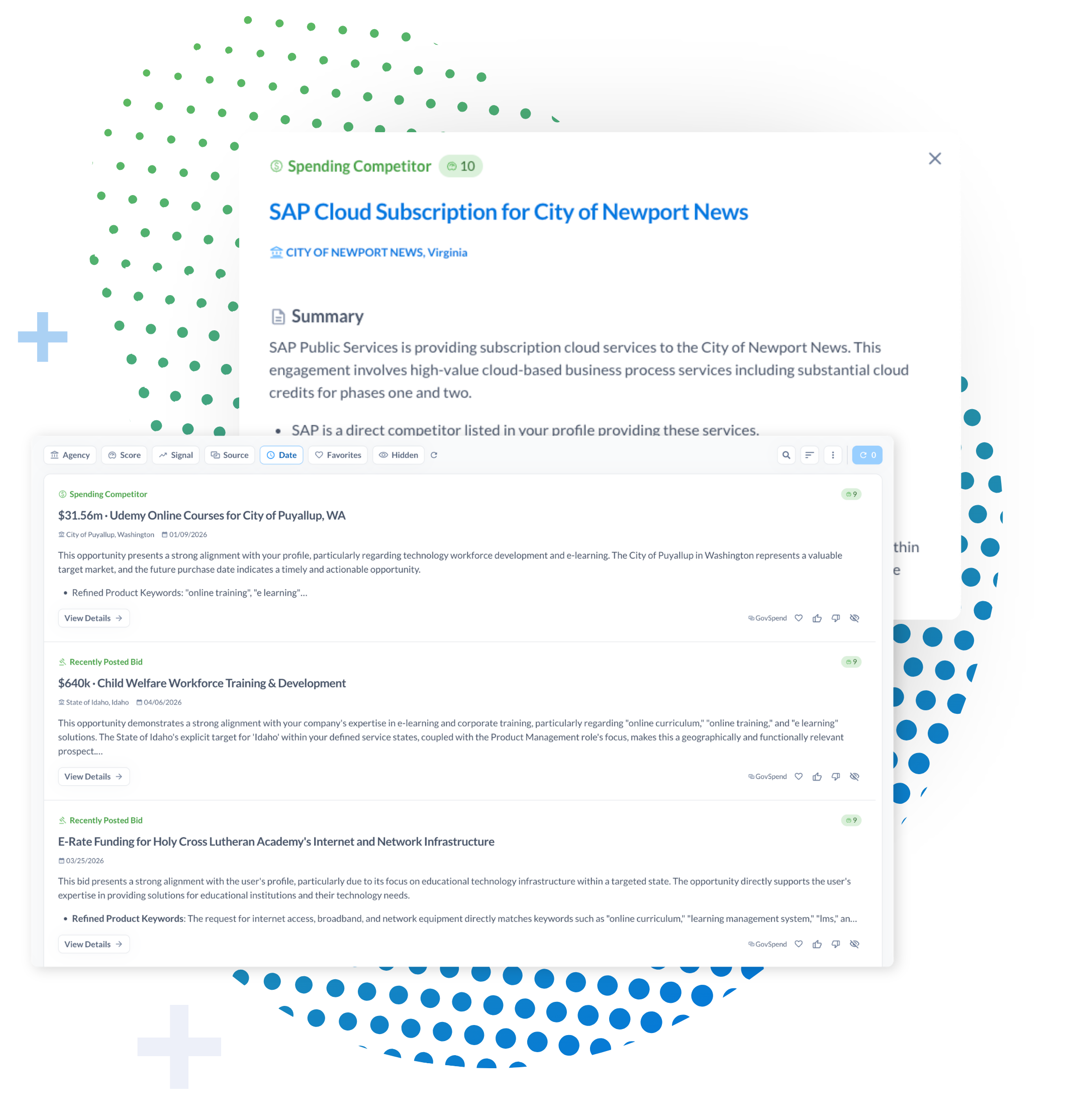
With access to contracts, historical RFPs, board activity, and purchase order data, the team gained a clearer picture of each account. Utilizing AI Search to identify and stack-rank the most promising opportunities, and AI Chat to pull the most relevant information from a data record, helped the team identify the signals in the noise. Instead of focusing only on what was currently out to bid, they could now identify when agencies were likely to buy, who they were working with, and how much they were spending.
That visibility made prioritization far more effective. The team began focusing on accounts approaching active buying cycles, while avoiding time spent on long-term contracts with little near-term opportunity. The result was more timely outreach, stronger conversations, and better positioning from the start.
A Data-Driven, Customer-Centered Sales Experience
GovSpend also changed how the team showed up in sales conversations.
Leveraging aggregated purchase order data, they began bringing forward a broader view of customer spend, often consolidating multiple years of purchasing activity across entire organizations. For many public sector entities, that level of visibility doesn’t exist internally due to siloed purchasing across departments.
By connecting those dots, the team shifted conversations from individual transactions to larger discussions around cost, efficiency, and consolidation, helping agencies rethink how they buy.
Critically, this data created value for the agencies themselves, not just for the sales team. The team helped agencies better understand their own spending patterns and, in some cases, identify savings opportunities they hadn’t previously recognized. They also saved agencies significant time by reducing the need to reprocess public records requests for information that the team could provide directly.
That dynamic shifted the relationship from vendor to trusted partner. Agencies weren’t just buying—they were coming back.
Being able to explain that this data was sourced through a subscription—not repeated public records requests—also helped establish credibility early. It positioned the team as transparent and professional, reducing friction and building trust from the outset.
The Results
As the team adapted, performance followed. They weren’t just managing more opportunities; they were winning more of them. Better timing and deeper account insight led to higher conversion rates and more productive engagement. Andrew noted that conversion rates in 2026 are significantly higher than the year before — driven not just by more bids, but by getting better at identifying which opportunities are worth pursuing in the first place.
At the same time, they eliminated a key risk: missing opportunities.
As Andrew put it, “at minimum, we’ve recouped our value by not missing any RFQ, RFP, or RFB processes in our footprint.”
GovSpend has also become embedded in their day-to-day sales execution. The team now uses the Opportunities module to deliver qualified leads to their sales staff daily while enriching their CRM with accurate, up-to-date prospect data. With greater visibility into competitors and market activity, they’re able to refine their positioning and approach each engagement with more context.
But perhaps the most meaningful outcome isn’t the volume of bids won—it’s the depth of relationships built. By helping agencies understand their own spending, save money, and reduce administrative burden, the team has become a genuine long-term partner to the accounts they serve. That trust translates into repeat business that doesn’t require competing on price alone.
The result is a more predictable, scalable model for public sector growth—built on better data, stronger timing, and relationships that compound over time.
“I will continue to endorse GovSpend for any sales organization serious about providing true vendor value in the government space—just not my competitors.”
— Andrew P., Director of Government Sales
Request time with our experts to learn how GovSpend can help you scale opportunities and build agency partnerships.